As part of your overall sustainability strategy, it is very important to include and communicate your wins with all employees. They should be invested in your goals and be encouraged to contibute.
However, as with many environmental narratives, it can be hard to conceptualise. CO2 is particularly hard to visualise in way that is easily understandable in context: we do not associate volume to a measurement of mass/weight easily.
Carbon Visuals
There is a useful way to visualise one tonne of CO2—using graphics like those from Carbon Visuals. One unit is equal to one cube of 8m by 8m filled with CO2, at 15 degrees Celsius and sea level pressure. You can see how this looks in the image below:
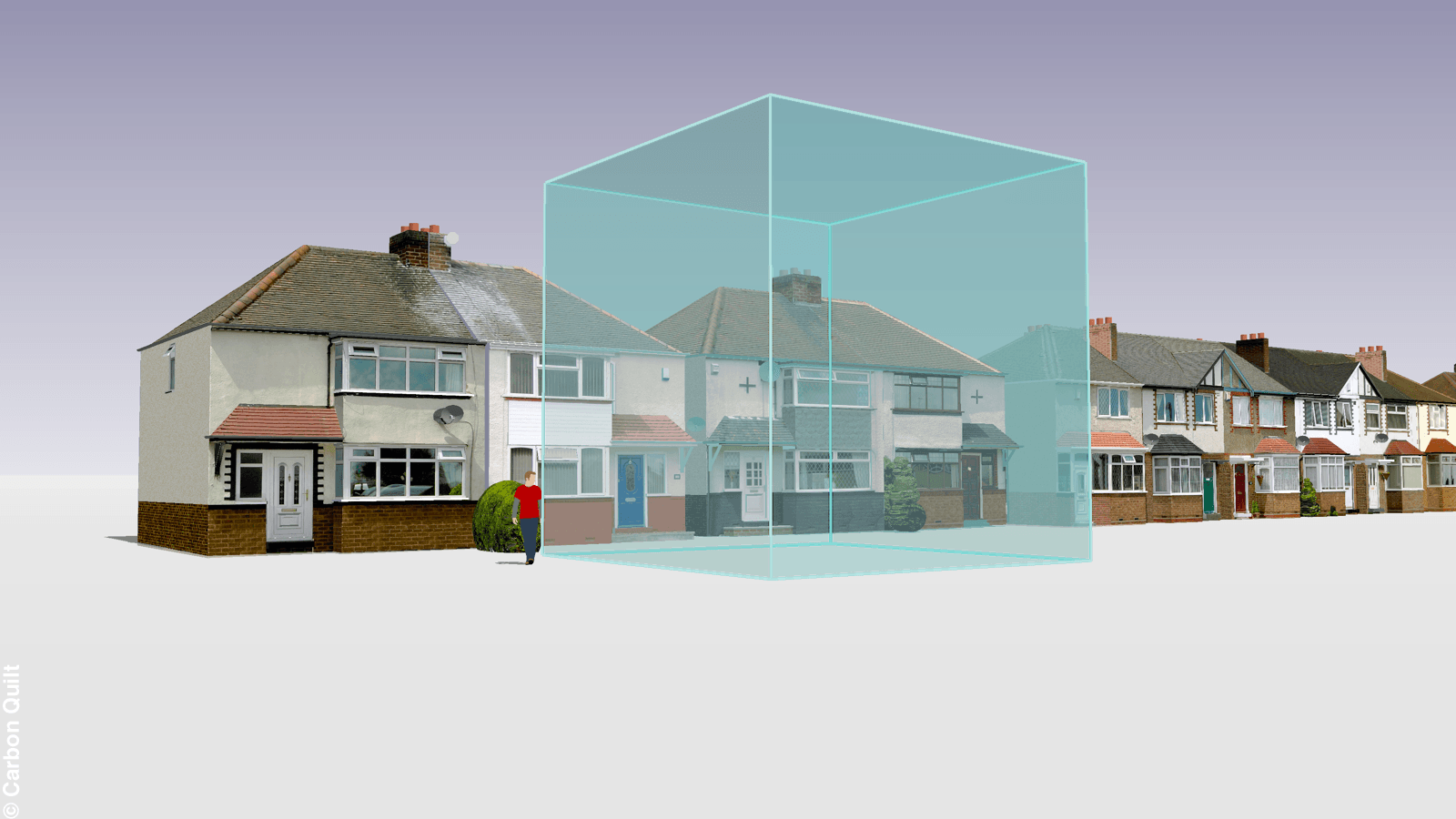
The average carbon footprint per person in the UK is estimated to be around 12 tonnes of CO2 per annum. Therefore, each of us are on average, per year, producing 12 cubes of CO2 like the one in the illustration.
Translating CO2 into activities
Another way to understand emissions is by translating carbon emissions into other activities that are easier to understand. To help organisations communicate their carbon footprint, we have deployed a tool on our website developed by EPA (USA Environment Protection Agency) that translates greenhouse gas emissions or energy consumption into some equivalences (based on US metrics and data).
For example, one tonne of CO2 is equivalent to:
- 2,500 miles driven by an average gasoline-powered passenger vehicle
- 120,000 smartphones charges
- 500 litres of Diesel consumed
- Just over 0.5 kilograms of HCFC-22 (commonly used in domestic and commercial refrigeration and air condition) released to the atmosphere
Presented as infographics, your data can be shared with stakeholders in ways that have much greater impact and emotional resonance. Communicating your sustainability strategy regularly is a vital pillar of success. If your major stakeholders, including your staff, are not invested in the process it will be harder to achieve results and you will not reap the full extent of reputational benefits in the future.
Feel free to try the EPA tool below and explore the equivalence of your energy consumption.