Fuel Type Breakdown
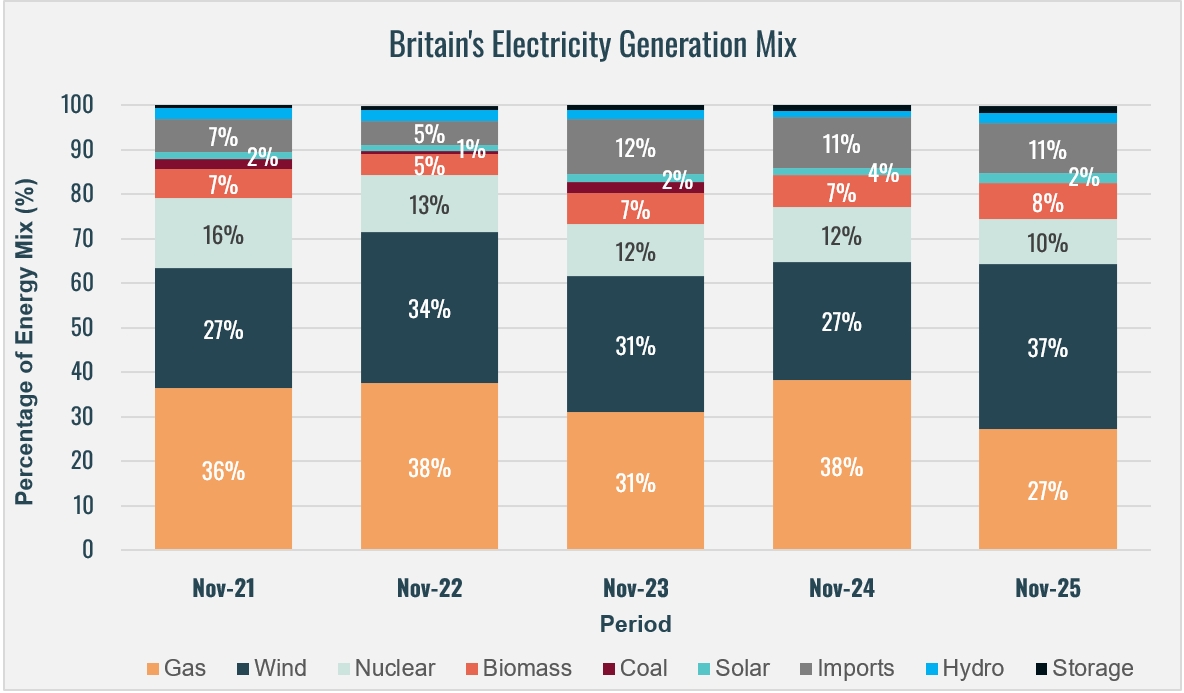
Britain's electricity generation in November 2025 was led by wind, which contributed 37% of the energy mix. This represents the highest November share in the past five years, up 10 percentage points compared to November 2024. Wind also outpaced gas generation by 10 percentage points, reinforcing its role as the dominant power source.
Gas supplied 27% of electricity in November 2025, marking its lowest November contribution over the last five years. This decline underscores ongoing progress in reducing reliance on fossil fuels and highlights the shifting balance towards renewable energy.
Electricity imports accounted for 11% of the generation mix, unchanged from November 2024 but slightly below the 12% seen in November 2023. This continued reliance on cross-border electricity reflects the need to balance intermittent domestic supply.
Nuclear power contributed 10% of the mix, down from 12% in both November 2023 and November 2024, and 6% below the level seen in November 2021, continuing a trend of reduced nuclear availability.
Solar generation provided 2% of Britain’s electricity, down from 4% in November 2024, but largely consistent with the previous years, indicating stable, though modest, contributions from solar during autumn.
Storage technologies supplied 2% of the mix, up 1 percentage point compared to November 2024, marking the highest November contribution in the past five years. This increase signals improvements in grid flexibility and battery deployment.
Biomass contributed 8%, up slightly from 7% in November 2024, while hydropower remained steady at 2%, consistent with levels over the previous five years.
Coal remained absent from the generation mix, continuing Britain’s phasing out of coal-fired power.
Zero-Carbon Sources & Carbon Intensity
Zero-carbon sources, including wind, solar, nuclear and hydro, delivered 66% of Britain’s electricity in November 2025, the highest November share in the past five years and a significant 24 percentage points higher than November 2024.
Carbon intensity fell sharply to 126 gCO₂/kWh in November 2025, a marked reduction compared to 171 gCO₂/kWh in November 2024 and the lowest November level in the past five years. On a rolling 12-month basis, carbon intensity remained low at 129 gCO₂/kWh, slightly higher than the previous period but still reflecting the impact of increased renewable generation.
The rolling 12-month average for zero-carbon generation is 55%, 4% higher than the previous 12-month period, highlighting steady long-term growth in low-carbon electricity sources.
Concluding Remarks
November 2025 was a strong month for Britain’s electricity transition. Wind delivered record November output, storage continued to support grid flexibility, and the zero-carbon share reached an all-time November high of 66%. Carbon intensity dropped to its lowest November level in five years, underlining the tangible benefits of renewables and flexible technologies.
Despite these gains, nuclear output remained lower than in previous years, and imports continued to play a role in balancing supply. To sustain momentum towards net zero, ongoing investment in domestic clean energy generation, storage, and flexible grid technologies remains essential.
Britain's Electricity Summary Charts
Monthly Statistics
To explore more insights, visit our interactive renewables map
here.
Data source: National Grid ESO 2025
(https://www.nationalgrideso.com/electricity-explained/electricity-and-me/great-britains-monthly-electricity-stats)